The Mulberry Harbour was built for D-Day in June 1944. The Mulberry Harbour’s purpose was to ease and speed up the unloading process so that Allied troops were supplied as they advanced across France after breaking out from Normandy. The success of D-Day could only be maintained if the advancing troops were supplied and more men landed. The Mulberry Harbour was one of the greatest engineering feats of World War Two.
|
|
Support for the harbours came from on high – Winston Churchill.
| “Piers for the use on beaches: They must float up and down with the tide. The anchor problem must be mastered………let me have the best solution worked out. Don’t argue the matter. The difficulties will argue for themselves.” |
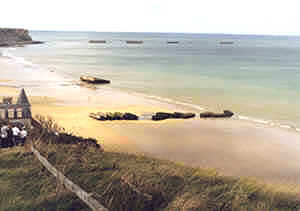
The Mulberry Harbour was actually two artificial harbours, which were towed across the English Channel and put together off the coast of Normandy. One, known as Mulberry A, was constructed at Omaha Beach and the other, known as Mulberry B (though nicknamed ‘Port Winston’), was constructed off Arromanches at Gold Beach. Put together like a vast jigsaw puzzle, when both were fully operational, they were capable of moving 7,000 tons of vehicles and goods each day.
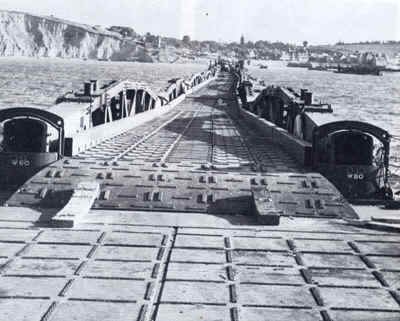
Each of the two artificial harbours was made up of about 6 miles of flexible steel roadways that floated on steel or concrete pontoons. The roadways were codenamed “Whales” and the pontoons “Beetles”. The ‘Whales’ ended at giant pier heads that had ‘legs’ that rested on the seabed. The whole structure was protected from the force of the sea by scuttled ships, sunken caissons and a line of floating breakwaters. The material requirements for any part of either Mulberry A or B were huge – 144,000 tons of concrete, 85,000 tons of ballast and 105,000 tons of steel.
|
|
The various parts of the Mulberry harbours were made around Britain in the greatest of secrecy. The many various parts were moved to Normandy immediately after June 6th – D-Day. By June 18th, both harbours were in use. They were meant to stay in use until the capture of Chebourg in the north of the Cotentin Peninsula.
However, a violent storm begun on June 19th. By June 22nd, the harbour serving the Americans at Omaha had been wrecked. Parts of it were salvaged to repair the British harbour at Gold which worked for 10 months. In that time this harbour landed 2.5 million men, 500,000 vehicles and 4 million tons of goods.
For all its apparent success, the idea of Mulberry did not have the support of everyone:
| “I think it’s the biggest waste of manpower and equipment that I have ever seen. I can unload a thousand LSTs at a time over the open beaches. Why give me something that anybody who’s ever seen the sea act upon 150-ton concrete blocks at Casablanca knows the first storm will destroy? What’s the use of building them just to have them destroyed and litter up the beaches.” (Admiral John Leslie Hall, US Navy) |